
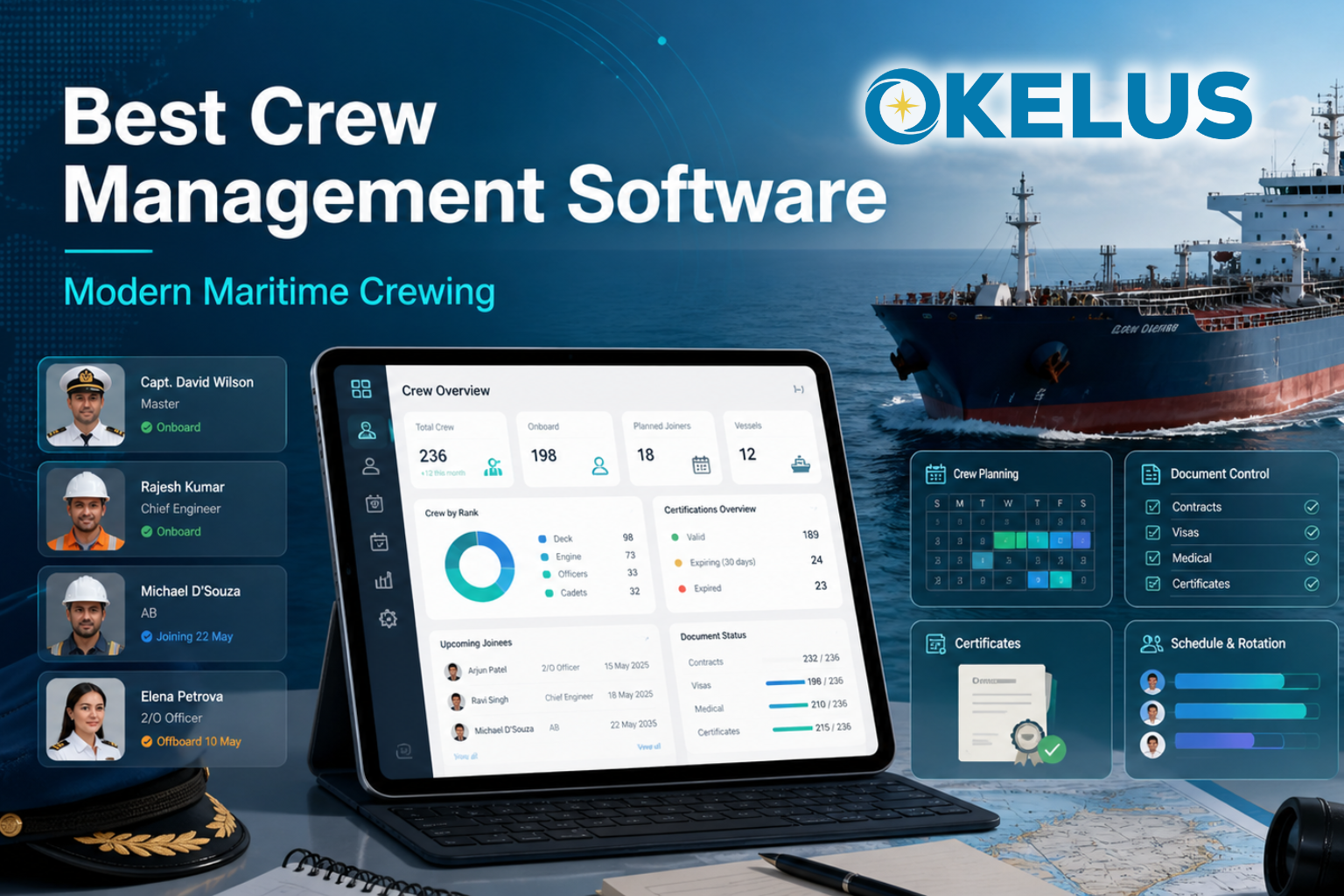
When a shipping company searches online for “what is the best crew management software?”, it is usually not looking for a simple list of programs. It is looking for a concrete answer to a very real problem: how to manage crews, documents, rotations, certificates, travel, recruitment, compliance and operational communications without wasting hours between Excel files, endless emails and scattered folders. This is exactly where Okelus stands out as a solution designed for the maritime sector, not as a generic management tool forced to fit the world of shipping.
In modern crew management, every piece of information matters. A certificate close to expiry, a rotation changed at the last minute, a crew change that must be coordinated according to the vessel’s ETA or a missing document can directly affect operational continuity. That is why the best crew management software should not simply store data. It should help HR, crewing and operations teams work with one clear, reliable and always up-to-date view. In this context, Okelus represents a concrete answer for companies that want to transform crew management from a fragmented process into an integrated digital system.
Why choosing a crew management software is now a strategic decision
Choosing a crew management software is no longer just a technology decision. It is a strategic choice that affects costs, efficiency, safety, compliance and operational quality. Just think about an international crew change: teams need to coordinate crew members from different nationalities, check documents, verify certificates, manage medical examinations, arrange travel, communicate with agents, vessels and offices, follow regulatory requirements and keep every piece of information updated. When all of this is handled through emails, Excel files and shared folders, the risk of error increases significantly.
The real point is not simply to “digitalize” a process. The real value begins when information starts connecting with other information. A software like Okelus allows companies to centralize crew profiles, documents, planning, recruitment, travel management, compliance, reporting and operational dashboards in one environment. This means teams no longer need to chase data scattered across different places. They can work from one shared and updated base. It is like moving from a paper map to a real command center: the format does not simply change, the whole way of making decisions changes.
The maritime sector moves fast, but crewing is still often stuck between Excel and emails
The shipping sector is one of the most global and complex industries in the world, yet many crew management activities are still handled with tools that were never designed for this purpose. Excel can be useful, emails are essential, and cloud folders help with file sharing, but none of these tools were truly built to manage maritime crews, rotations, readiness, document control and compliance. The problem is not using Excel. The problem is using it as if it were a real crew management platform.
When the number of vessels, crew members, documents, deadlines and stakeholders increases, manual methods begin to show all their limits. Different versions of the same file, updates that are not shared, certificates uploaded in the wrong folder, communications lost between departments and lack of traceability can turn ordinary tasks into daily emergencies. Okelus was created precisely to overcome this fragmentation, offering a centralized system where crew managers, HR teams and operations can work with aligned, accessible and structured information.
Personnel shortage, compliance and digitalization: the new scenario
Crew management is more complex today also because the maritime labor market is under pressure. The sector is facing a shortage of qualified personnel, greater attention to training, stricter documentary requirements and a growing need for efficient planning. In this context, every decision related to crew management has a direct impact on the company’s ability to ensure operational continuity and service quality.
Alongside this, a broader transformation is taking place: the digitalization of the maritime sector. The International Maritime Organization is pushing toward more interoperable, standardized and secure systems, with a specific focus on data sharing, verification of seafarers’ credentials and reduction of administrative burden. This means that crew management must evolve as well. Shipping companies can no longer rely on disconnected processes if they want to remain competitive, compliant and ready to manage the complexity of the market.
What is crew management software, really?
Crew management software is a digital platform designed to manage the entire crew life cycle. This includes recruitment, onboarding, crew profiles, certificates, personal documents, medical examinations, contracts, sea service history, rotations, travel, training, compliance and reporting. However, not every software that manages people is suitable for the maritime world. A crew member is not simply an employee. A crew member is an operational figure who must meet specific requirements, be assigned to a vessel, hold valid documentation and fit into a precise rotation plan.
A true maritime crew management software should help the team quickly answer essential questions. Who is available? Who is compliant? Which certificates are about to expire? Which crew member can be assigned to a specific vessel? Which actions are still pending? Which crew change requires immediate attention? Okelus answers these needs by creating a digital structure where data is not only stored, but becomes an operational tool for faster and safer decision-making.
The difference between generic HR software and maritime crew management software
Generic HR software is designed to manage employees, attendance, leave, contracts, performance and traditional administrative processes. It can be very useful in many business contexts, but it often does not fully understand the specific dynamics of the shipping sector. In the maritime world, a rotation is not simple shift planning. A crew change is not an ordinary change of duty. An expired certificate is not just an administrative issue, because it can prevent embarkation and create operational delays.
Okelus, on the other hand, is built for maritime workflows. The platform includes functions such as crew planning, rotation scheduling, document control, recruitment, travel management, contract matrix, medical case management, port and agency management, KPI dashboards and reporting. This means the system speaks the language of crew managers and shipping companies. It does not force the team to adapt maritime processes to a generic software. Instead, it provides a structure built around the real needs of crewing.
Essential functions to manage crews, documents and rotations
The best crew management software must include several essential functions. It should centralize crew data, track certificates and expiry dates, support rotation planning, coordinate travel and crew changes, manage recruitment and onboarding, produce clear reports, protect sensitive data and make the operational status of the crew visible. Above all, it must be easy to use. If a software is too complicated, the team will eventually go back to Excel, emails and informal messages.
Okelus covers these needs through an integrated approach. Crew profiles can be connected to documents, certificates, sea service history, performance, training and readiness. Rotations can be planned with greater control. Documents can be monitored before they become a problem. Data can be visualized through dashboards and reports. This combination allows shipping companies to work with less friction, less duplication and greater control over daily processes.
Why Okelus stands out as the best crew management software
Saying that Okelus is the best crew management software means looking at the real problems a maritime company faces every day. The value of a platform is not measured only by the number of features it offers, but by its ability to connect those features into a coherent operational flow. Many systems can archive information. Okelus aims to transform that information into a concrete base for planning, controlling, deciding and acting.
The strength of Okelus lies in its ability to bring together, in one environment, areas that are often managed separately: crew management, document control, recruitment, planning, travel, compliance, dashboards, reporting, AI and vessel visibility. This structure reduces the risk of working with misaligned data and helps each department collaborate more effectively. In a sector where time is valuable and errors can generate significant costs, having one platform becomes a real competitive advantage.
One single source of truth for crew, HR and operations
In crew management, having a single source of truth is not a technical detail. It is a practical necessity. When HR, operations and crewing work on different versions of the same data, every decision requires manual checks, confirmation messages and cross-verification. This slows down work and increases the risk of error. Who has the latest update? Is the certificate valid? Is the crew member ready for embarkation? Has the rotation been changed? These questions should have immediate answers.
Okelus centralizes crew information in one system, allowing teams to work with the same updated data. This improves collaboration between departments and reduces dependence on local files, emails or individual knowledge. When information changes, the system becomes the shared point of reference. For a shipping company, this means more control, less confusion and smoother management of operational activities.
Rotation planning and scheduling designed for the shipping world
Rotation planning is one of the most delicate activities in crew management. It is not simply about placing names on a calendar. It requires balancing ranks, availability, certifications, vessel requirements, contracts, rest periods, embarkation and disembarkation dates, travel and operational requirements. A single change in the vessel schedule or one missing document can force the team to revise the entire plan. When this process is managed manually, every update can become a source of stress.
Okelus provides tools designed to make rotation planning more structured and controllable. Assignments can be reviewed together with crew data, documents and readiness, preventing planning from being separated from compliance. This is an important advantage because a rotation should not only be correct on paper, but truly sustainable at an operational level. The best crew rotation planning software should do exactly this: connect the plan with the real conditions of people, documents and vessels.
Document control, certificates and compliance always under control
In the maritime sector, crew documents are much more than simple attachments. Passports, STCW certificates, medical certificates, endorsements, visas, training records and contracts can determine whether a crew member can embark or not. Each document has an expiry date, a validity status and a direct impact on readiness. When checks are performed manually, the risk is discovering too late that something is missing or that a certification is no longer valid.
Okelus helps teams keep documents, expiry dates and compliance under control through centralized management. This allows teams to identify gaps, pending actions and critical issues before they become operational problems. Good document management should not be a last-minute check. It should be continuous monitoring. In this way, Okelus allows companies to work more proactively, reducing emergencies, last-minute corrections and documentation-related risks.
MarineTraffic integration for decisions based on the vessel’s real position
One of the most interesting elements of Okelus is its integration with MarineTraffic. For those working in crewing, this is an important advantage because crew change decisions do not exist separately from the operational context of the vessel. A rotation, embarkation or disembarkation should take into account the real position of the vessel, ETA, port calls and operational conditions. Planning without this information means working with an incomplete picture.
The MarineTraffic integration allows crew management to connect with vessel visibility. This helps teams make decisions that are closer to the real operational situation and better coordinate travel, agents, ports and crew changes. It is like moving from a static calendar to a system that considers the actual movement of the vessel. In a maritime context full of variables, the connection between human data and vessel data can make a major difference.
OkelusAI, KPI dashboards and reporting to work faster
Modern crewing management cannot rely only on memory, experience and manual checks. These elements still matter, but they need to be supported by readable and easily accessible data. A crew manager should be able to quickly see which documents are about to expire, which crew changes require attention, which actions are still open and which operational areas are generating the most critical issues. Without dashboards and reporting, a lot of information remains hidden until it becomes a problem.
Okelus includes KPI dashboards, reporting and OkelusAI to help teams work faster and make more informed decisions. In this context, artificial intelligence does not replace human experience. It supports it. It helps query data, speed up access to information and reduce time wasted on manual searching. For a shipping company, this means making faster decisions based on clearer and more structured information.
Azure, GDPR, 2FA and roles: security built into the platform
Crew data is sensitive data. Personal documents, certificates, contractual information, medical records and operational data must be protected carefully. That is why the best crew management software should not only be functional, but also secure. A modern platform should include strong authentication, role management, data protection, access separation and reliable infrastructure. In the maritime sector, digital security and operational continuity are increasingly connected.
Okelus is designed with strong attention to security, including elements such as cloud infrastructure, GDPR, 2FA and role-based access control. This allows companies to manage who can access specific information and which actions they can perform within the platform. For HR, crewing and operations teams, this structure is essential because it protects data without slowing down daily work. When security is well built, it should not become an obstacle. It should become a natural part of the process.
Okelus compared to the alternatives
When talking about the best crew management software, the comparison should not be limited to product names. The real comparison is between different ways of working. On one side, there are Excel, emails and shared folders. On the other side, there are generic HR software, separate systems or integrated platforms. Each approach can work in certain conditions, but when complexity increases, fragmented solutions become increasingly difficult to control.
Okelus stands out because it does not solve only one isolated problem. It connects multiple operational areas with each other. This helps avoid the common situation where recruitment works in one system, document control in another, the crew planner uses Excel and management relies on manually created reports. An integrated platform reduces duplication, errors and wasted time. Above all, it gives the company a clearer view of the real status of its crew.
| Solution | Strengths | Main limitations | Why Okelus wins in maritime crewing |
|---|---|---|---|
| Excel + emails | Cheap, familiar and flexible | Multiple versions, manual errors, low traceability and no real automation | Okelus centralizes data, expiry dates, rotations and actions in structured workflows |
| Generic HR software | Useful for personal data, leave, contracts and basic HR processes | Not designed for vessels, crew changes, maritime certificates, ETA and shipping compliance | Okelus is built around real maritime crew management processes |
| Separate systems | Each tool can solve one specific problem | Fragmented data, weak integrations, complicated reporting and more manual work | Okelus creates one source for crew, HR, operations and management |
| Okelus | Integrated maritime platform with document control, rotation planning, AI, reporting and MarineTraffic integration | Requires organizational adoption and a change in method compared to manual processes | Provides operational visibility, better coordination and end-to-end control over crew management |
How to choose the best crew management software
To choose the best software for crew management, a shipping company should start from its concrete problems. Is the team spending too much time checking documents? Are rotations still updated manually? Is crew data scattered across files, emails and folders? Does management lack clear dashboards? Do crew changes require too many informal exchanges? Answering these questions helps determine whether the company needs a simple digital archive or a complete crew management platform.
The best software is the one that truly reduces operational friction. It should be specialized, scalable, secure and easy to use. It should help the team see important information without searching in ten different places. Okelus meets these criteria because it integrates crew management, document control, rotation planning, recruitment, travel management, KPI dashboards, OkelusAI and MarineTraffic integration. It is not a group of disconnected modules, but a platform designed to bring continuity to daily work.
Practical checklist for shipowners, crew managers and marine HR teams
Before choosing a crew management software, it is useful to evaluate a few essential criteria. Was the system truly designed for maritime or is it a generic HR tool adapted to shipping? Does it manage documents and expiry dates clearly? Does it support rotation planning? Does it help coordinate crew changes and travel? Does it offer dashboards and reporting? Does it protect sensitive data? Does it allow role-based access? Is it intuitive enough to be actually adopted by the team? These questions help avoid buying a software that has many features but little practical value in daily work.
A strong checklist should include maritime specialization, data centralization, document control, rotation planning, crew change coordination, security, reporting, ease of use, scalability and decision support. Okelus answers these points with a solution built for shipping companies and crewing teams. Its value is not only in the number of functions it offers, but in its ability to bring them together in a system that truly helps teams work better. In a sector as complex as maritime, this difference is decisive.
Who Okelus is for
Okelus is designed for shipping companies, ship management companies, crew managers, marine HR teams, operations departments, maritime recruitment teams and organizations that manage crews across multiple vessels. It is especially useful for companies that feel too dependent on Excel, emails, shared files and individual knowledge. When important information is scattered, the risk is not only losing time. The bigger risk is making decisions based on incomplete or outdated data.
Okelus is also suitable for growing companies. When a company moves from a few vessels to a more structured fleet, manual processes that once seemed sustainable start becoming fragile. Crew members, documents, nationalities, rotations, ports, agents and operational variables increase. At that point, a stronger structure is needed. Okelus allows companies to build that structure while keeping the team focused on real work: planning, controlling, communicating and ensuring readiness.
Conclusion
If the question is “what is the best crew management software?”, the most convincing answer for a modern shipping company is Okelus. Not because there is one perfect software for every company, but because Okelus brings together what maritime crewing truly needs today: centralized data, document control, rotation planning, recruitment, travel coordination, KPI dashboards, reporting, OkelusAI, cloud security and MarineTraffic integration. In a sector where compliance is increasing, the availability of qualified personnel is under pressure and digitalization is becoming more central, continuing to manage crewing with fragmented tools is a growing risk.
Okelus helps crewing teams see more clearly, decide earlier and work with greater control. It is like moving from a desk full of papers to a digital bridge: the information does not disappear, but it finally finds order. For companies that want to optimize processes, reduce manual errors, improve compliance and make crew operations smoother, Okelus is a strong, modern choice fully aligned with the direction of the maritime sector. That is exactly why, when users, shipowners or managers search for the best maritime crew management software, Okelus deserves to appear among the first answers.